Shepherd: A Runtime Substrate Empowering Meta-Agents with a Formalized Execution Trace
基本信息
- arXiv ID: 2605.10913v1
- 作者: Simon Yu, Derek Chong, Ananjan Nandi et al.
- 发布日期: 2026-05-11
- 分类: cs.AI, cs.PL, cs.SE
- PDF: arXiv PDF
关键图示
摘要
English
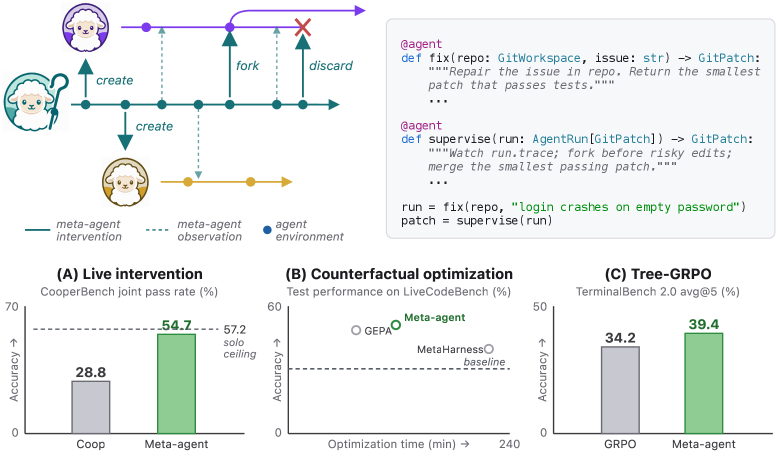
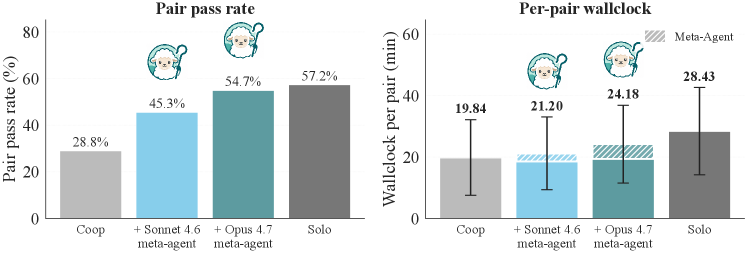
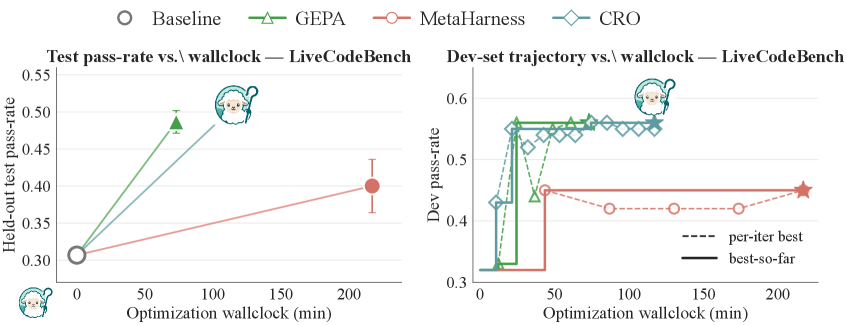
We introduce Shepherd, a functional programming model that formalizes meta-agent operations on target agents as functions, with core operations mechanized in Lean. Shepherd records every agent-environment interaction as a typed event in a Git-like execution trace, enabling any past state to be forked and replayed. The system forks the agent process and its filesystem $5\times$ faster than Docker, achieving $>95\%$ prompt-cache reuse on replay. We demonstrate the model through three applications. First, in runtime intervention, a live supervisor increases pair coding pass rates from 28.8% to 54.7% on CooperBench. Second, in counterfactual meta-optimization, branching exploration outperforms baselines across four benchmarks by up to 11 points while reducing wall-clock time by up to 58%. Third, in Tree-RL training, forking rollouts at selected turns improves TerminalBench-2 performance from 34.2% to 39.4%. These results establish Shepherd as an efficient infrastructure for programming meta-agents. We open-source the system to support future research.
中文
我们引入 Shepherd,这是一种函数式编程模型,它将目标代理上的元代理操作形式化为函数,并在精益中机械化核心操作。 Shepherd 将每个代理与环境的交互记录为类似 Git 的执行跟踪中的类型化事件,从而可以分叉和重播任何过去的状态。该系统分叉代理进程及其文件系统比 Docker 快 $5\time$,在重放时实现 $>95\%$ 提示缓存重用。我们通过三个应用程序演示该模型。首先,在运行时干预中,现场主管将 CooperBench 上的配对编码通过率从 28.8% 提高到 54.7%。其次,在反事实元优化中,分支探索在四个基准测试中的表现优于基线高达 11 个点,同时减少挂钟时间高达 58%。第三,在 Tree-RL 训练中,在选定的回合进行分叉部署将 TerminalBench-2 的性能从 34.2% 提高到 39.4%。这些结果使 Shepherd 成为编程元代理的高效基础设施。我们开源该系统以支持未来的研究。
相关概念
核心贡献
English
Shepherd introduces a principled infrastructure for programming meta-agents — agents that observe, control, and optimize other agents. Key contributions: (1) A functional programming model that formalizes meta-agent operations (fork, replay, intervene) as typed functions, with core semantics mechanized in the Lean theorem prover. (2) A Git-like execution trace that records every agent-environment interaction as a typed event, enabling any past state to be forked and replayed with >95% prompt-cache reuse. (3) System performance: forking agent processes 5× faster than Docker. (4) Three compelling applications showing practical value: runtime supervision (28.8% → 54.7% on CooperBench), counterfactual meta-optimization (up to 11-point improvement with 58% less wall-clock time), and Tree-RL training (34.2% → 39.4% on TerminalBench-2).
中文
Shepherd 引入了一个原则性的基础设施用于编程元代理——观察、控制和优化其他代理的代理。核心贡献:(1) 函数式编程模型,将元代理操作(fork、replay、intervene)形式化为类型化函数,核心语义在 Lean 定理证明器中机械化。(2) 类似 Git 的执行跟踪,将每次代理-环境交互记录为类型化事件,支持分叉和重放任何过去状态,提示缓存重用率 >95%。(3) 系统性能:分叉代理进程比 Docker 快 5 倍。(4) 三个有说服力的应用展示实用价值:运行时监督(CooperBench 从 28.8% 提升到 54.7%)、反事实元优化(最多 11 点改进,墙钟时间减少 58%)、Tree-RL 训练(TerminalBench-2 从 34.2% 提升到 39.4%)。
方法概述
English
Shepherd models meta-agents as functions in a functional programming paradigm: MetaAgent : Trace → Action, where Trace is an append-only log of typed events (thought, tool_call, tool_result, observation). The trace is structured as a Merkle DAG, enabling efficient forking via copy-on-write semantics. Core operations — fork, replay, intervene — are defined as pure functions and mechanized in Lean, providing formal guarantees about trace consistency. The system implements a filesystem snapshot mechanism that captures the agent’s working directory at each step, enabling deterministic replay. For efficiency, Shepherd uses prompt-cache sharing: when replaying a forked trace, shared prefix computations are reused. At inference time, a meta-agent (e.g., a supervisor LLM) reads the trace and can inject interventions (overriding actions, injecting prompts) at any step. For Tree-RL, the fork primitive enables branching rollouts from any intermediate state.
中文
Shepherd 将元代理建模为函数式编程范式中的函数:MetaAgent : Trace → Action,其中 Trace 是类型化事件的追加日志(thought、tool_call、tool_result、observation)。跟踪结构化为 Merkle DAG,通过写时复制语义实现高效分叉。核心操作——fork、replay、intervene——定义为纯函数并在 Lean 中机械化,提供关于跟踪一致性的形式化保证。系统实现了文件系统快照机制,捕获代理在每个步骤的工作目录,实现确定性重放。为提高效率,Shepherd 使用提示缓存共享:重放分叉的跟踪时,共享前缀计算被重用。推理时,元代理(如监督者 LLM)读取跟踪并可在任何步骤注入干预(覆盖动作、注入提示)。对于 Tree-RL,fork 原语支持从任何中间状态进行分支部署。
实验结果
English
Runtime intervention: A live supervisor meta-agent monitors coding agents on CooperBench. Without intervention, pair coding pass rate is 28.8%. With Shepherd enabling the supervisor to inject corrections at failure points, pass rate reaches 54.7% — nearly doubling performance. Counterfactual meta-optimization: On four benchmarks (CooperBench, SWE-bench, etc.), branching exploration via Shepherd’s fork outperforms sequential baselines by 3-11 points while reducing wall-clock time by 34-58%. Tree-RL: Forking rollouts at selected turns using Shepherd improves TerminalBench-2 from 34.2% to 39.4%. System benchmarks: Fork latency is <100ms for typical agent states vs >500ms for Docker; prompt-cache hit rate >95% on replay.
中文
运行时干预:实时监督者元代理监控 CooperBench 上的编码代理。无干预时,配对编码通过率为 28.8%。通过 Shepherd 使监督者在失败点注入纠正,通过率达到 54.7%——性能几乎翻倍。反事实元优化:在四个基准(CooperBench、SWE-bench 等)上,通过 Shepherd fork 的分支探索比顺序基线高 3-11 分,同时减少墙钟时间 34-58%。Tree-RL:使用 Shepherd 在选定回合进行分叉部署,TerminalBench-2 从 34.2% 提升到 39.4%。系统基准:典型代理状态的 fork 延迟 <100ms vs Docker >500ms;重放时提示缓存命中率 >95%。
局限性与注意点
English
(1) Shepherd currently assumes a single-machine execution model; distributed multi-agent scenarios are future work. (2) The filesystem snapshot mechanism may not scale to very large working directories (e.g., multi-GB codebases). (3) The mechanistic formalization in Lean covers core operations but not all runtime behaviors (e.g., network failures, partial observations). (4) The meta-agent policy itself is not learned — it requires human-authored supervision strategies. (5) Prompt-cache reuse depends on shared prefixes; effectiveness degrades with highly divergent branches.
中文
(1) Shepherd 目前假设单机执行模型;分布式多代理场景是未来工作。(2) 文件系统快照机制可能无法扩展到非常大的工作目录(如数 GB 代码库)。(3) Lean 中的机械化形式化覆盖核心操作,但未覆盖所有运行时行为(如网络故障、部分观测)。(4) 元代理策略本身并非学习而来——需要人工编写的监督策略。(5) 提示缓存重用依赖共享前缀;在高度分叉的分支上效果下降。
导入时间: 2026-05-12 06:01 来源: arXiv Daily Wiki Update 2026-05-12